
Exhibition stands need print that holds up from build-up to pack-down
Exhibition work is different from ordinary signage. Panels are handled more often, moved between venues, assembled by different teams and often reused for more than one show. That means the print has to stay sharp, the colour has to remain consistent across every panel, and the substrate must suit the structure it will be fixed to.
For stand builders and marketing teams, the usual challenge is not only getting a good visual. It is making sure the full set of parts works together: rigid graphics, header panels, counter fronts, lightbox faces where needed and directional pieces that guide visitors into the stand. A good flatbed UV workflow helps with this because it supports direct printing onto rigid sheets with fast handling and controlled finishing.
In exhibition halls in Johannesburg, Durban, Cape Town and Gqeberha, stands may also be affected by dust, transport vibration and short setup windows. That is why panel choice, print order and final trimming all matter. If the layout is planned badly, you can lose time on site and that is expensive when the crew is working to a venue deadline.
Typical panel sets for exhibition displays
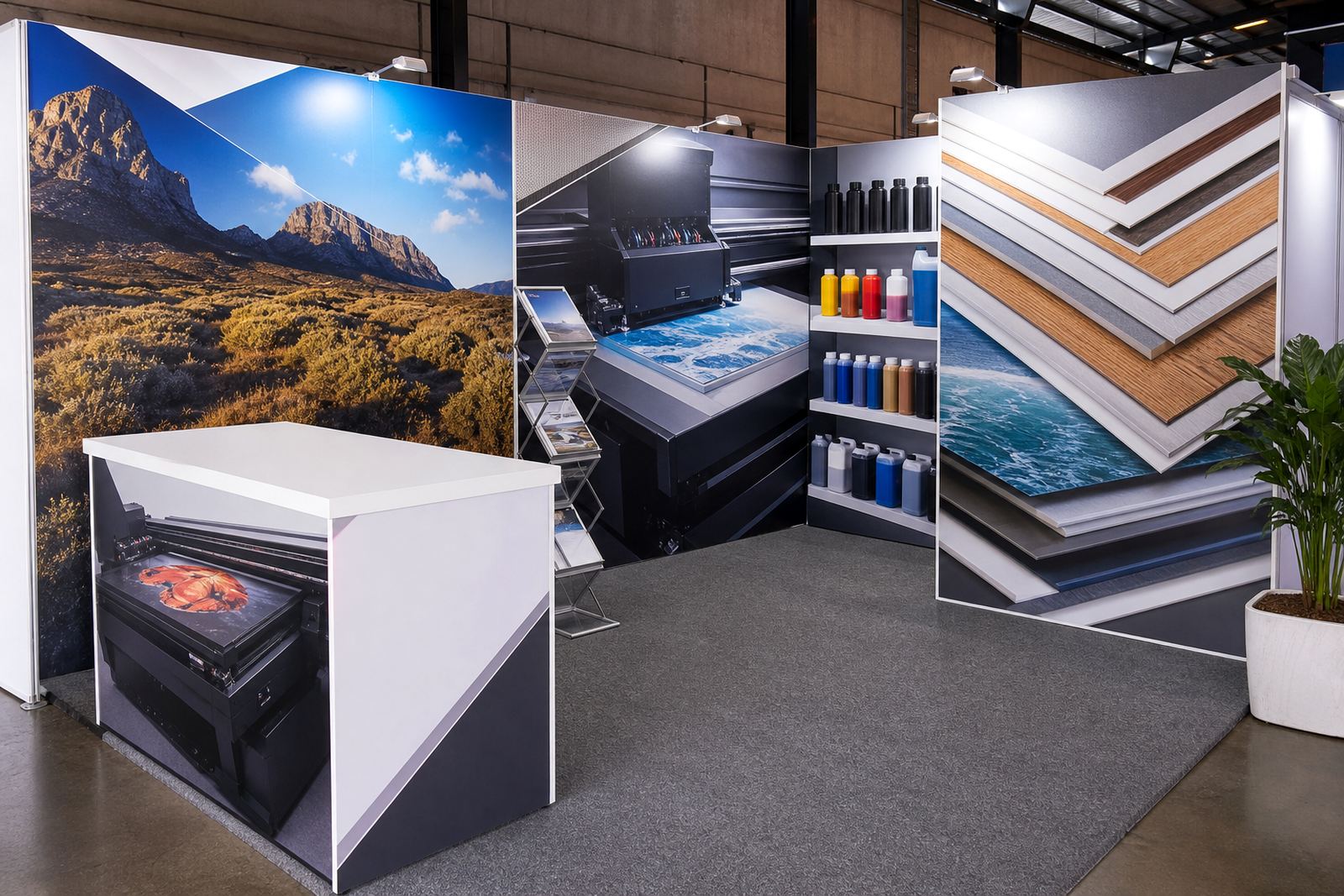
Most exhibition display jobs use a mix of rigid boards and supporting structures. The exact set depends on the size of the stand, whether it is modular or custom built, and whether the client wants a single-use presentation or a reusable system for several shows.
- Rigid wall panels for main brand graphics and product messaging
- Counter front panels for reception points and demo stations
- Header boards for stand names, hall visibility and wayfinding
- Freestanding direction panels for entrances and internal routes
- Feature panels for product launches, photo backdrops and stage areas
- Replacement panels for stands that are reused and updated often
Flatbed UV printing is usually chosen for these parts because it supports a wide range of rigid media and gives a direct print finish that can be suitable for indoor exhibition use. In some cases you may also need a protective approach for transport, especially if the panels are being moved between province-to-province events. That starts with the media, not just the artwork.
How to plan the layout before a single sheet is printed
A stand layout should be checked before production begins. The print team needs final dimensions, fixing positions, access points, and the order in which the stand will be assembled. If the drawings are still changing, the print run becomes risky and waste can climb quickly.
We normally advise clients to separate the project into three steps: visual planning, production planning and installation planning. Visual planning covers the artwork, brand placement and reading distance. Production planning covers panel sizes, panel joins and the print sequence. Installation planning covers how the crew will unload, carry and fit the parts at the venue. If any one of these is weak, you can run into delays at pack-in.
For busy exhibition weeks in Gauteng, good planning also helps with load-shedding and machine scheduling. You do not want a half-printed panel or a rushed reprint because the layout was not checked properly. Clear file naming, marked panel sets and a simple sign-off process can save hours.
- Confirm final stand dimensions before print release
- Allow for joins, trims and fixing points
- Keep key text away from edges and corners
- Match colour across all panels in the set
- Label every panel for fast site assembly
Common mistakes that cost time at venue level
One of the most common mistakes is choosing the wrong material for the structure. A board that looks fine in the studio may sag, chip or crack when it is carried through a hall or fixed to a frame. Another problem is mixing panel thicknesses in one stand without checking that the joins will line up neatly.
Colour control is another issue. Exhibition stands often use a lot of solid brand colour, large images and bold headings. If the print process is not consistent, one panel can look warmer or darker than the next, and the stand starts to look untidy even if the artwork is correct. That is especially noticeable under venue lighting.
Teams also underestimate handling. Panels can get scratched when they are stacked badly, or damaged by rushed tape removal after install. If the stand is going to travel back to the office or to another city, proper packing is not optional. A little care here saves a lot of money later, simple as that.
- Using media that is too light for repeated handling
- Not allowing enough drying or curing time before packing
- Sending artwork with low resolution images
- Ignoring venue lighting and reflective surfaces
- Forgetting spare fixings, trims and touch-up items
Budget ranges for exhibition display printing in Rand
Budget for exhibition work should be set around the full job, not only the print. A small set of rigid display panels for a basic stand can start in the lower Rand thousands, while a larger custom exhibition build with multiple printed faces, replacement boards and coordinated finishing can move into a much higher range. The final figure depends on size, board type, quantity, finishing and whether the job includes installation support.
For South African exhibitors, it helps to cost three levels: entry, mid-range and premium. Entry-level work usually suits a small show, a single counter and a few wall panels. Mid-range work suits a standard shell scheme or custom stand with a clearer brand presence. Premium work suits larger stands, repeated events and projects that need careful colour matching across many parts. If you are planning a national roadshow, it is often better to budget for re-use rather than treat each event as a one-off.
When comparing budgets, include transit risk, spares and time on site. A cheaper print that fails during setup is not a saving. For exhibition clients in Germiston, Johannesburg, Pretoria, Durban, Cape Town and Gqeberha, the smarter approach is to price the full workflow properly from the start.
Installation, training and support for event timelines
Exhibition deadlines are tight, so support needs to be practical and quick. Flatbed UV assists with printer installation, site preparation, operator training, workflow planning, colour guidance and preventive maintenance. If a stand team is new to rigid board production, training makes a big difference because the work is only reliable when everyone understands the process.
Support can also include breakdown help, remote guidance, ink handling assistance, media testing, spares coordination and production consulting. For exhibition work this matters because the same stand may be revised many times before the final event. A small change in panel size or substrate can affect the whole build, and the sooner that is picked up, the better.
Our Germiston base supports clients across South Africa through the enquiry form on the contact page, with area support for Germiston, Johannesburg, Pretoria, Durban, Cape Town, Gqeberha, East Rand and Centurion. That local reach is useful when a show date is close and the work has to be kept moving.