Start With The Job Spec Before You Lift Anything
Good packing is not about using the most material, it is about using the right material in the right place. Use clean interleaving between sheets when boards must be stacked, and keep hard particles away from the print face. A small speck of grit can leave a scratch that only shows once the panel is installed under lights.
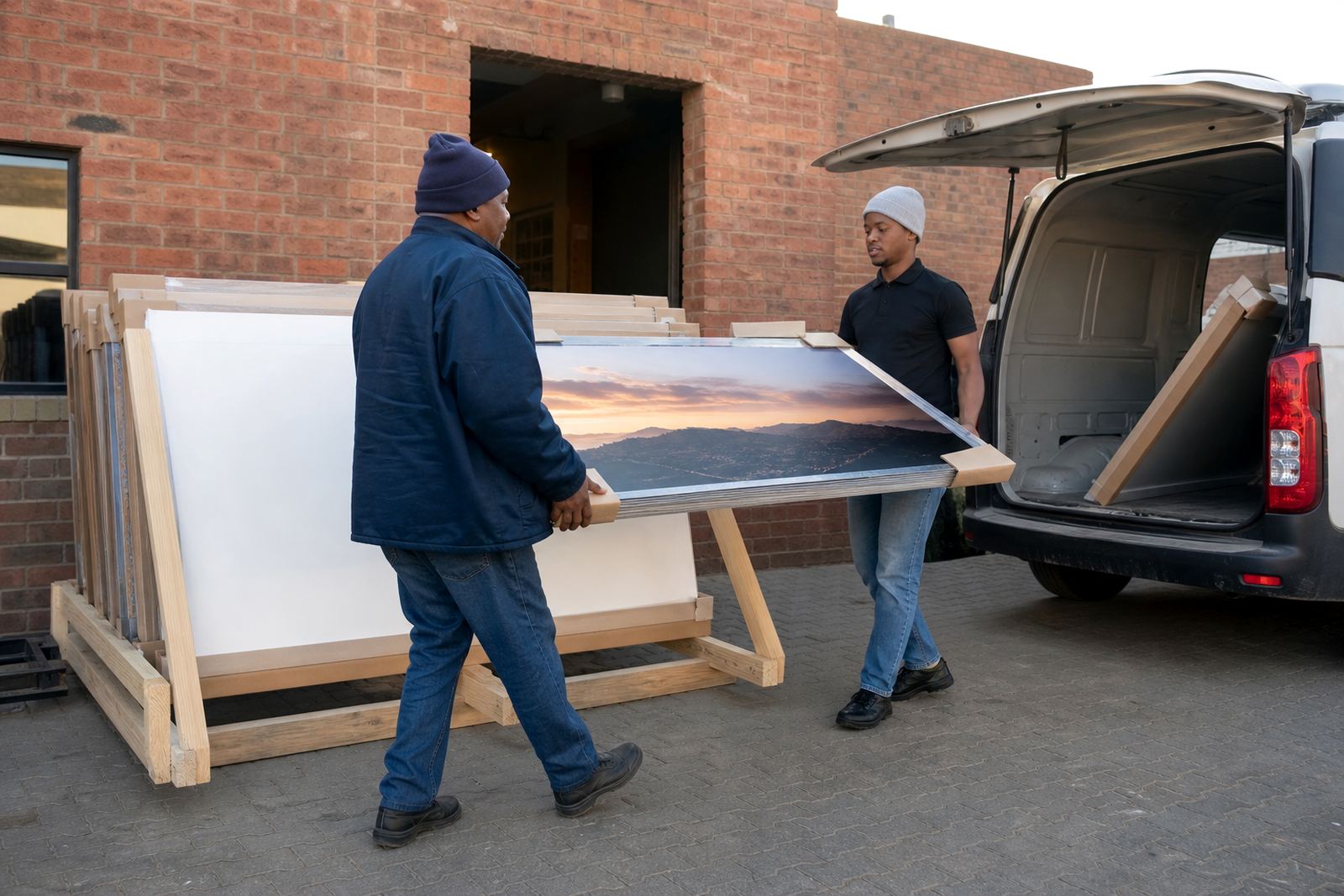
For larger rigid prints, add edge protection and keep the stack flat. If boards must be stood on edge for a short distance, make sure they are secured so they cannot lean and rub. Never trap a print under loose straps without corner protection, because pressure points can mark the surface. In our climate, moisture in cardboard or timber can also leave a print smelling musty or cause slight edge swelling, so dry packing materials matter.
- Use clean sheets between printed faces.
- Protect corners with padded or rigid corner guards.
- Keep straps over packing, not directly on the print surface.
- Avoid mixed stacking with tools, offcuts or metal fittings.
Load Vehicle Space So The Prints Do Not Move
Damage often happens at handover, not only in transit. Before anything is unloaded, inspect the receiving area. Look for wet floors, narrow passages, low door frames, active building work and poor lighting. If the site is on a busy retail road or inside a managed estate, ask where the offloading point is and whether there are any access rules. Some sites require delivery during a specific window, and that matters for a smooth handover.
When the boards come off the vehicle, count and check them against the job ticket. Do not let panels be dragged over concrete, paving or steel steps. If a board is large, get enough hands on it so the weight stays even. A bent corner can start as a small issue and end up making the whole sign unusable. If there is any doubt, photograph the item before install begins and report the issue before moving on. It saves arguments later.
- Confirm quantity before unpacking all the material.
- Check for corner damage, surface scuffing and edge chips.
- Keep prints off damp floors and wet grass.
- Store the job flat and under cover if installation is delayed.
Handle Printed Boards In Storage Without Leaving Marks
A solid delivery routine is usually the same every time. It starts with a clear job ticket, then moves through packing, loading, transport and site handover. When that routine is followed, the risk of chipped corners, scuffed faces and missing parts drops fast. The goal is not only to get the prints there, but to get them there in install-ready condition.
Our Germiston base supports printers and production teams across Gauteng and the rest of South Africa with installation, training, maintenance and practical workflow guidance. If you are managing rigid board output, ask for a delivery and handling process that matches your media, your route and your site conditions. Small changes in packing and handling often make the biggest differance.
- Confirm the board type and finish before packing.
- Protect faces, edges and corners before loading.
- Secure the load so it cannot shift in transit.
- Inspect again on arrival and store correctly until install.