
Why rigid boards need more than a quick wrap
Flatbed UV printed boards are often used for retail signage, indoor displays, site boards and temporary promotions. The problem is that these jobs are usually moved more than once. A board can be lifted, stacked, loaded, offloaded and carried through a store or office before it is fixed in place, so the packing has to protect it at every step.
Most transport damage is not dramatic. It is usually corner knocks, scuffed faces, bent edges, print rub marks or dust that sticks to a tacky surface. In humid areas such as Durban or on dusty routes around Germiston and the East Rand, the risk goes up if the board is not fully dry, not separated properly or left in the open before delivery.
The goal is simple: keep the board flat, keep the printed face clean and stop movement inside the vehicle.
Start with the right board finish and print handling
Packaging begins before the first sheet is wrapped. If the print needs a protective finish, plan for it as part of the job rather than as an afterthought. Some boards travel better with a laminated face, while others need careful stacking and face protection only. The right choice depends on where the board is going, how long it will be in transit and how it will be installed.
UV ink gives strong colour and good adhesion on many rigid media, but fresh prints still need sensible handling. Allow enough curing time, especially when the board will be packed closely or sent out on the same day. If the surface is still sensitive, sheet-to-sheet contact can leave marks that only show once the client unpacks the job.
- Allow prints to cure fully before wrapping or stacking.
- Keep the printed face clean and dry before packing.
- Separate glossy faces from each other with protective sheets.
- Check edge condition before a board leaves the factory floor.
Use corner, edge and face protection together
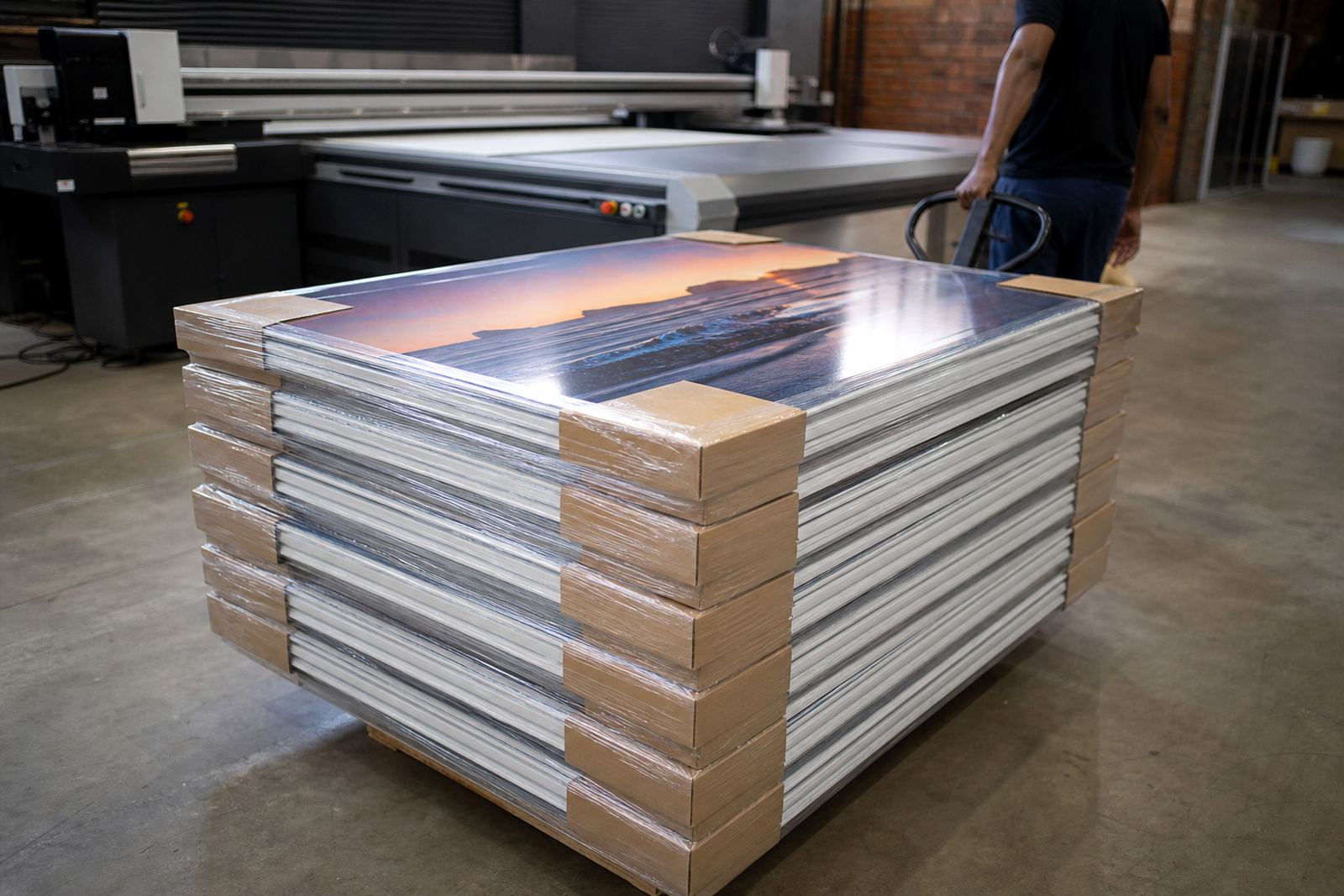
A board may be rigid, but the edges are usually the first part to take a knock. Corner protectors, edge strips and face sheets work best as a system. If one part is missing, the board still has a weak point. For larger sheets, the packaging should spread pressure across the whole surface rather than letting straps or ropes press into one area.
When boards are being carried through narrow passages or loaded into smaller vehicles, the corners are often the danger area. A clean corner chip can ruin a premium sign, especially where the board has a dark edge or a full coverage background. For that reason, it is worth taking a few extra minutes to protect the edges properly instead of trying to repair damage later.
Practical packaging items that help include:
- Corner protectors on all exposed corners.
- Clean interleaving sheets between printed faces.
- Stretch wrap or shrink wrap to hold the pack together.
- Flat, stiff backing boards for thinner rigid material.
- Labels that show the upright side and the print side.
Stacking, strapping and transport on South African roads
Many delivery problems start in the vehicle. Boards that are stacked loose can shift under braking, especially on motorway traffic between Johannesburg and Pretoria or during stop-start runs in central Cape Town. If a load moves even a few millimetres, the top board can scuff the print below it or buckle a corner against the side of the van.
Boards should lie flat on a level surface wherever possible. If the vehicle layout forces a vertical load, the boards need secure support along the whole length and a firm barrier so they cannot slide. Straps must be tight enough to stop movement but not so tight that they mark the board. In some cases, a soft protective layer under the strap is a simple fix that saves a lot of trouble.
For longer routes, especially into coastal humidity or hot inland weather, keep packs dry and out of direct sun. Heat can soften some packing materials and cause sheets to stick or warp. Rain and roadside dust are just as bad if the load bay is not properly covered.
Choose packaging based on the final use of the board
Not every rigid print needs the same level of protection. A short local delivery to a contractor in Germiston may need a different approach from a board that is going to Durban for installation after a few days in storage. The packaging should match the board size, the surface finish and the way the client will handle it on arrival.
If the board will be handed over at a warehouse, heavier packaging may be worth it. If it goes straight from the delivery vehicle to wall mounting, the main concern is surface protection and easy unpacking. Where the sign will be reused for an event, the pack should also be easy to open and re-seal without damaging the print.
It helps to agree the handling method before the job starts. That way, the print team, the packer and the delivery driver all know whether the board must stay face up, whether it can be nested and how it should be unloaded on site.
A practical example from Germiston to a retail site
A simple retail board going from Germiston to a store in Centurion may seem like a straightforward delivery, but the packing still needs care. The board could move from the production table to a storage rack, then into a courier van, then into a loading bay and finally into the shop floor. Each handover adds a chance for corner damage or a print mark.
In a case like that, the best result usually comes from clear labelling, a dry pack, corner protection and a stable load position in the vehicle. If the board is part of a larger campaign, matching the same packing method across every item also helps the install team work faster on site.
One missed step can turn a clean print into a return trip. That means extra labour, extra fuel and delays that could have been avoided with a few minutes of planning.
How a tighter workflow protects the finished job
Packaging works best when it is built into the workflow, not added at the end. From print planning to delivery, each stage should answer the same question: how will this board arrive in the same condition it left the printer?
That is where site preparation, workflow planning and production support matter. A sensible process can reduce waste, make loading faster and lower the risk of reprints. It also helps with busy periods when multiple boards are moving through the shop at once and everyone is working under time pressure.
For South African sign work, practical packaging is not about making a board look neat in the pack. It is about making sure the client receives a clean, usable product that can be installed without drama.